📄 Digital PDF book · read on your phone or print

Every rule, light, buoy and plot on the OUPV exam. with the degrees, the rule number or the steps in one box

Rules of the Road, lights and day shapes, sound signals, buoys, chart plotting, tides and the safety rules for the USCG six-pack license. You look at the situation from above or head-on, then read the degrees, the rule number or the steps in a box marked THE KEY. 68 pages in 9 parts.

Price US$ 27 US$ 63

Show me the pages

🔒 Secure checkout · PDF by email · 30-day guarantee

Sources: USCG Navigation Rules, 46 CFR Part 10, NOAA Chart No. 1 and tide predictions

Real pages

A look inside the pages

Every page pairs one big drawing of the situation with a box that holds what you need to remember: the arc in degrees, the rule number or the steps in order.
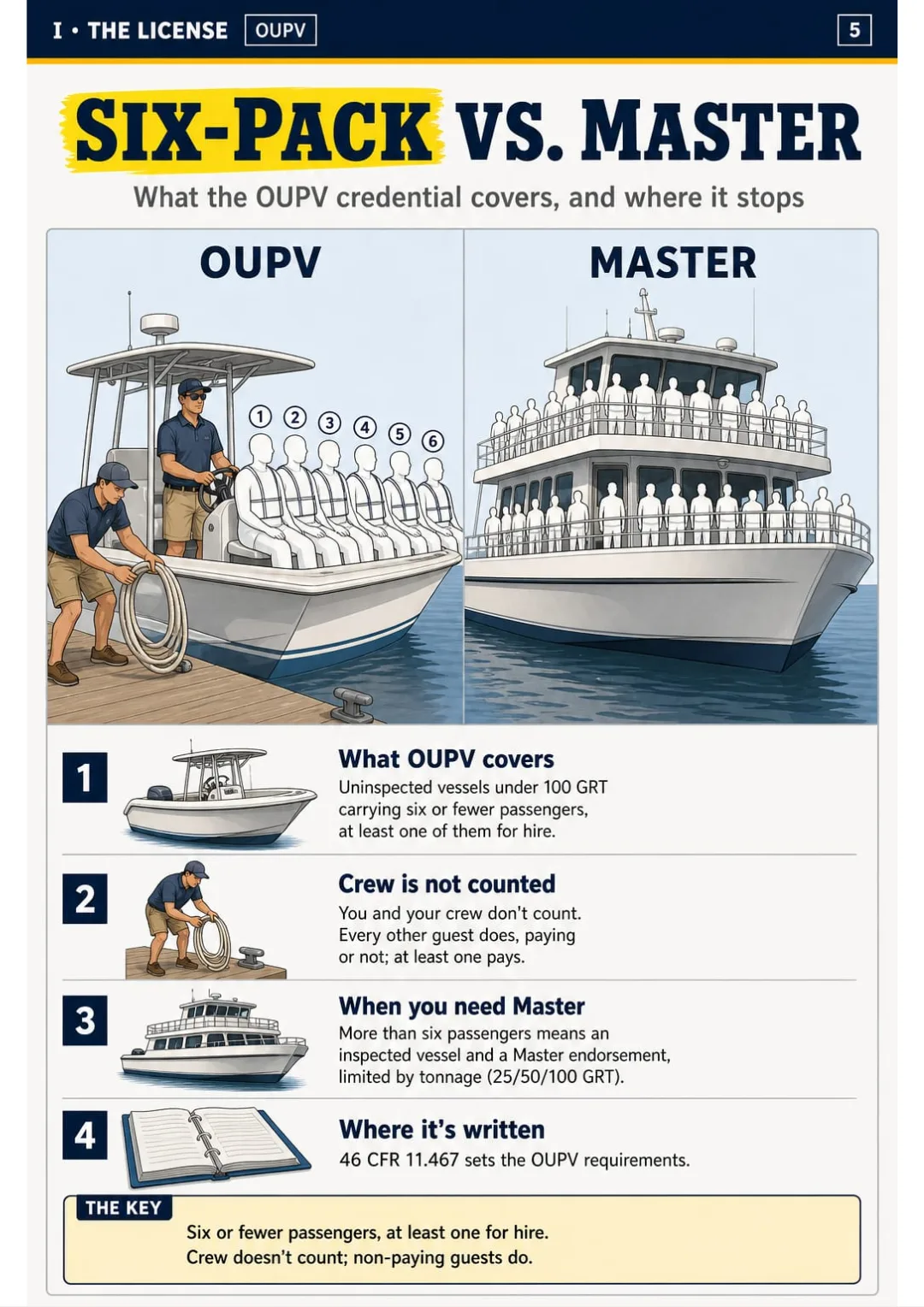
OUPV: under 100 GRT, six or fewer passengers, at least one for hire; crew doesn't count.
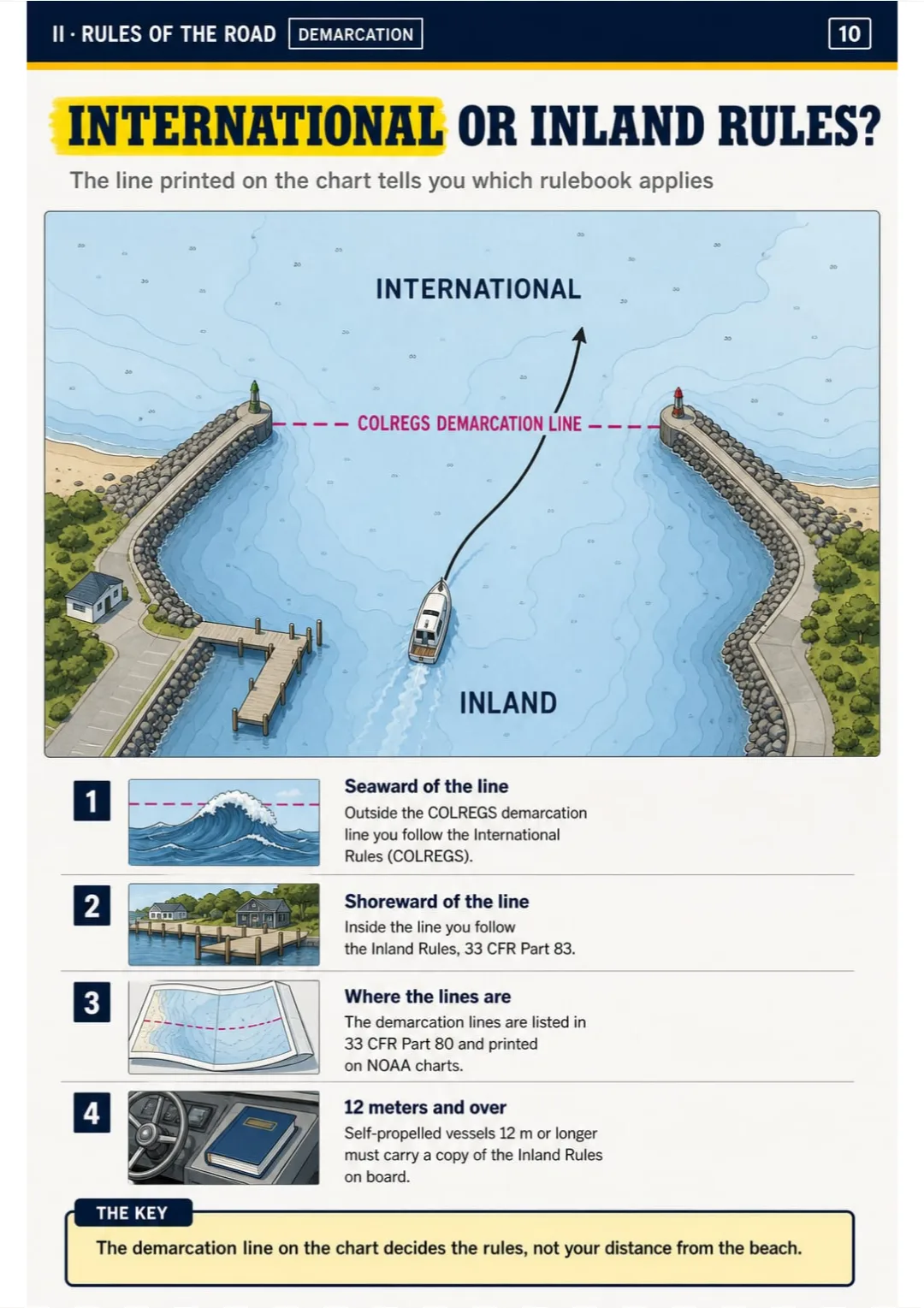
Seaward of the 33 CFR 80 line: COLREGS. Shoreward: Inland Rules, 33 CFR 83.
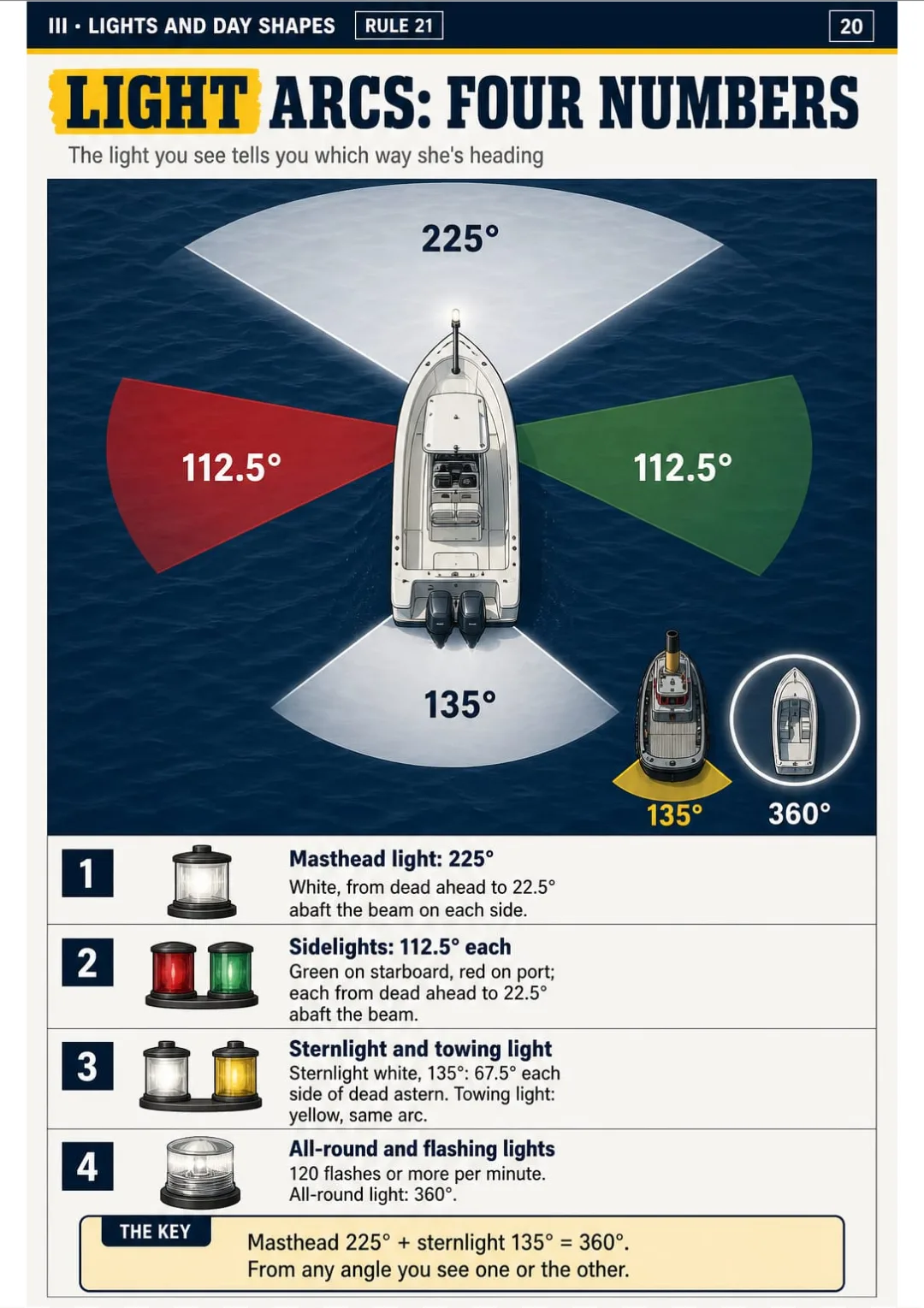
Masthead 225°, sidelights 112.5° each, sternlight 135°, all-round 360° (Rule 21).
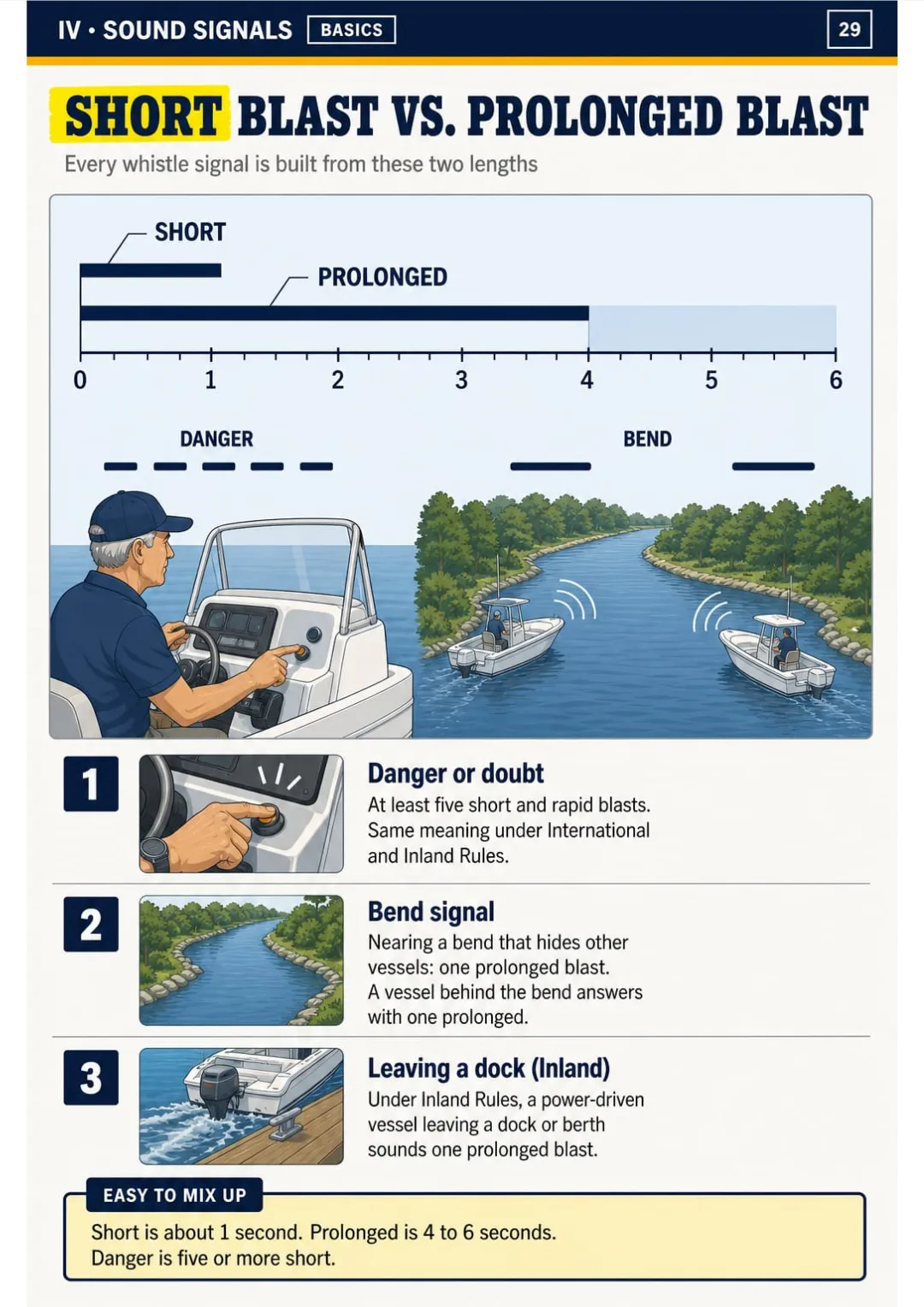
Short blast ≈ 1 second · prolonged 4–6 seconds · danger signal = at least 5 short and rapid
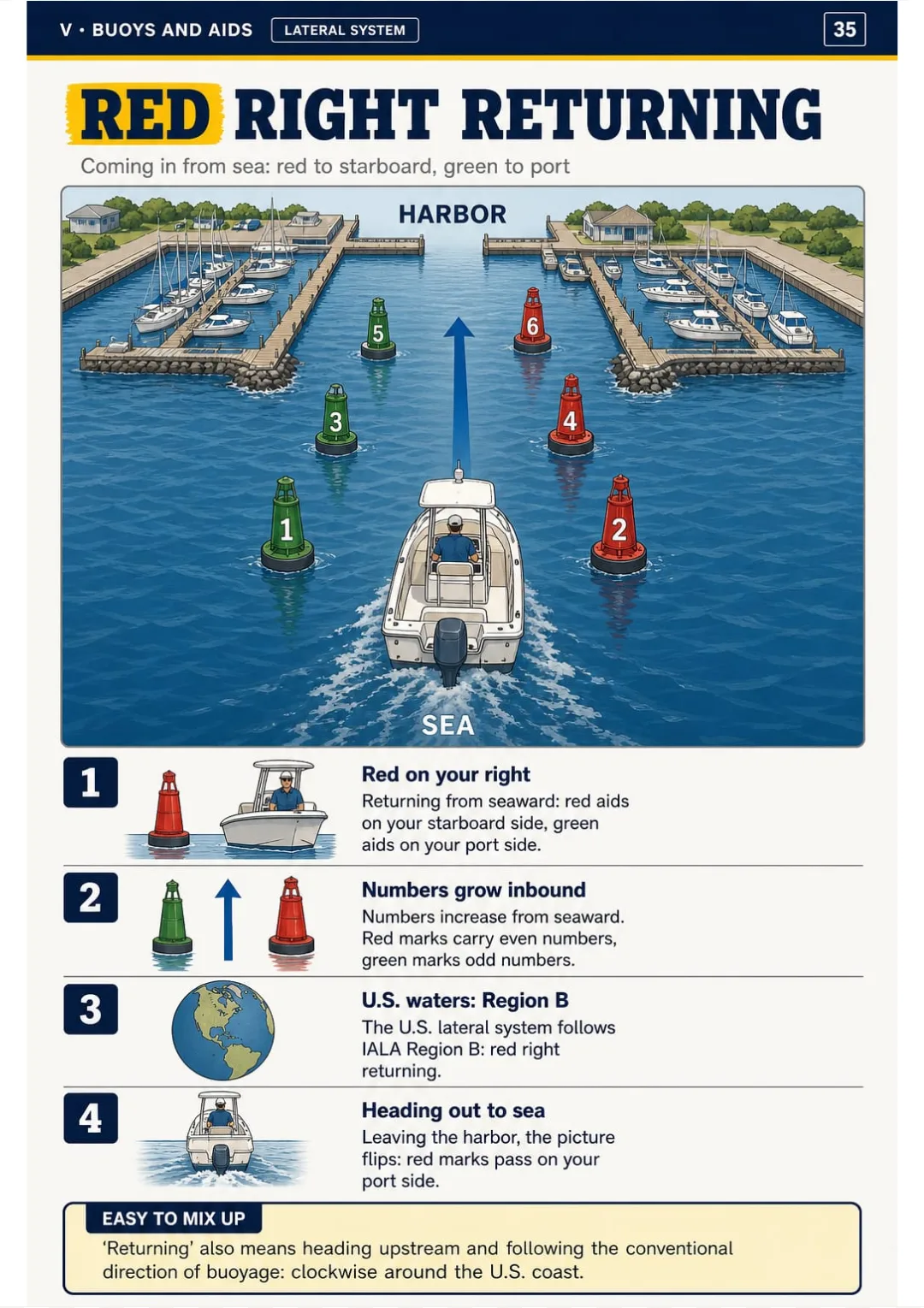
Returning from seaward: red even-numbered marks to starboard, green odd-numbered to port, numbers increasing inbound.
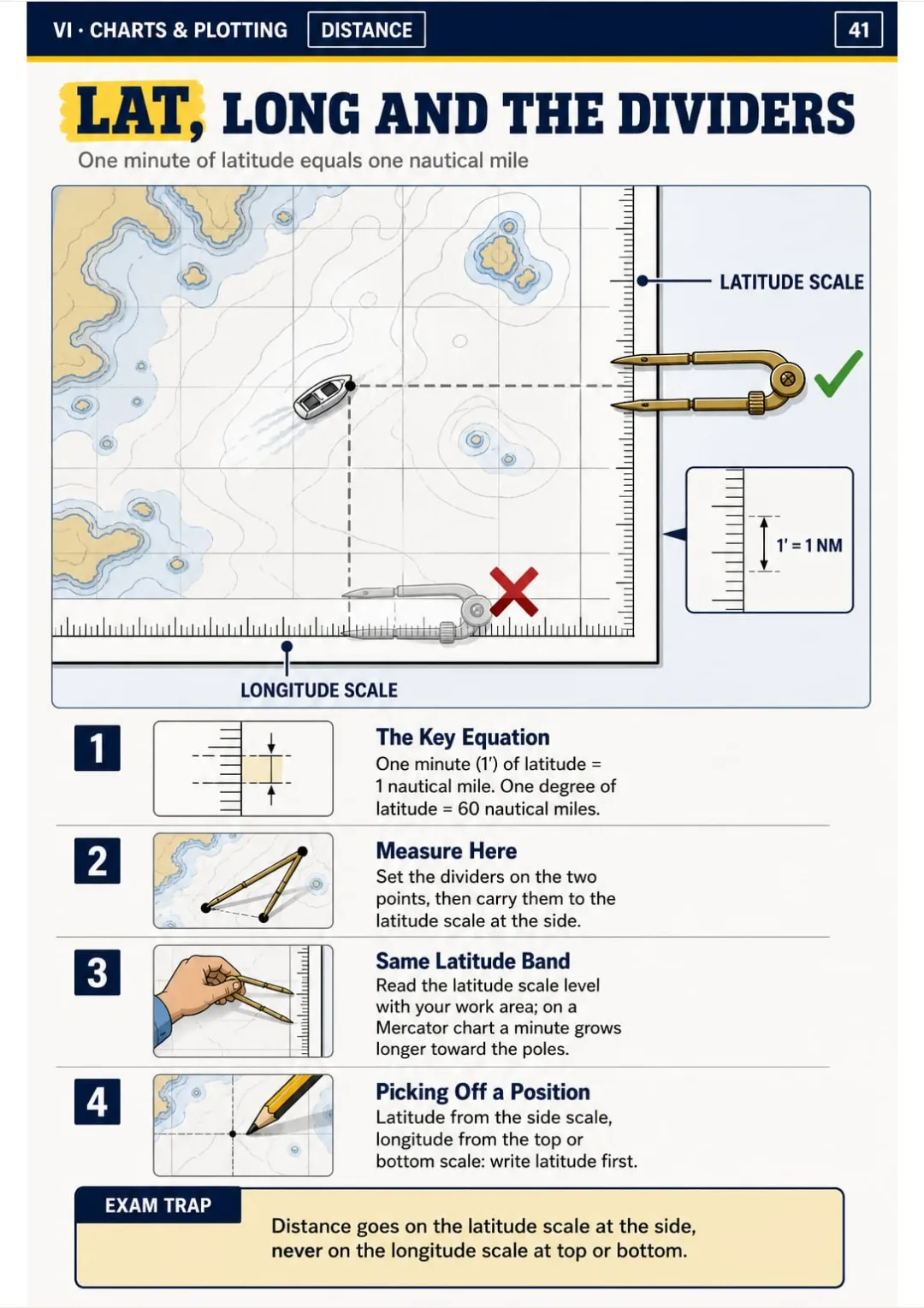
1' of latitude = 1 nautical mile: measure on the side scale, never the bottom one.
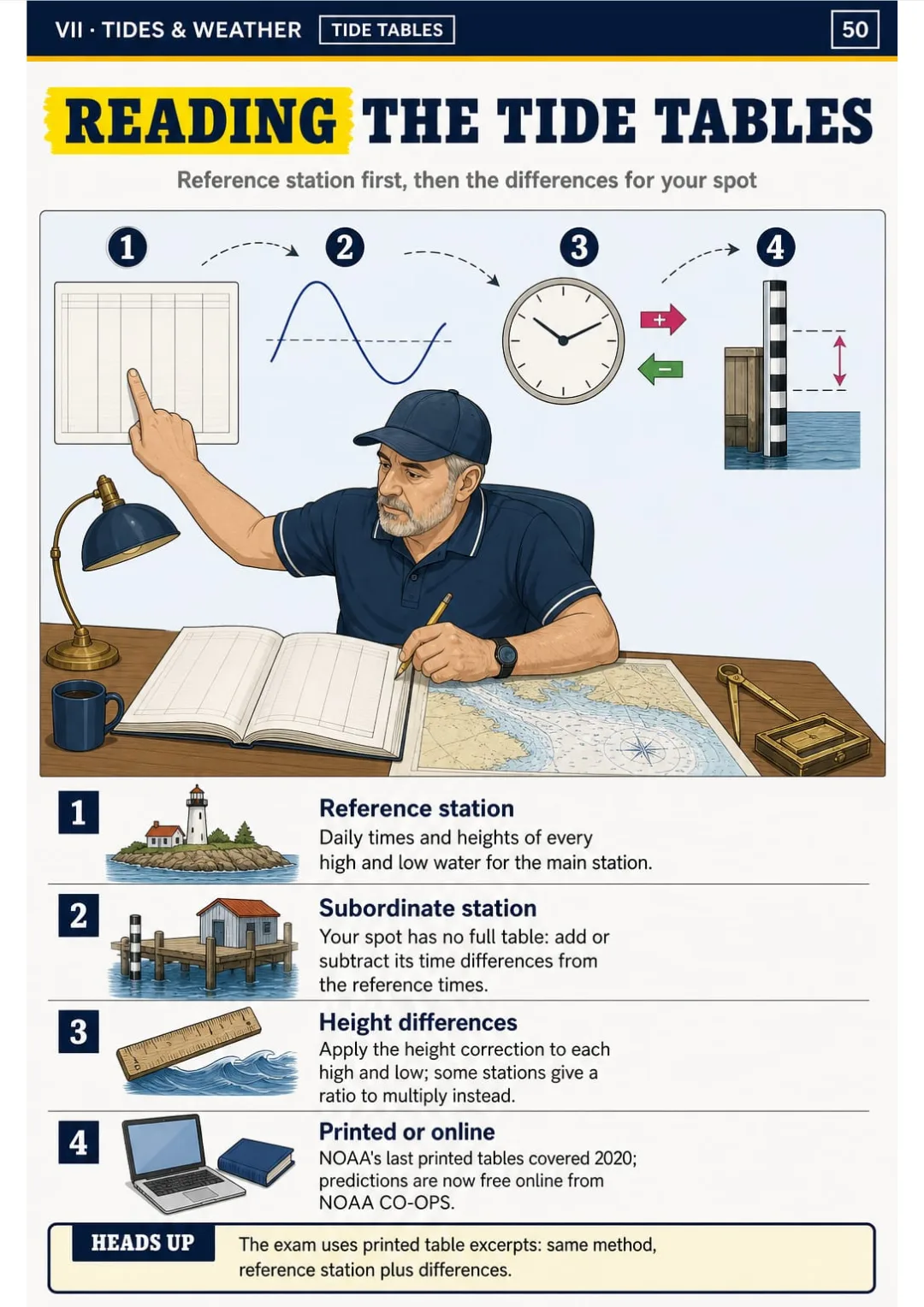
Reference station + time and height differences = the tide at your dock.
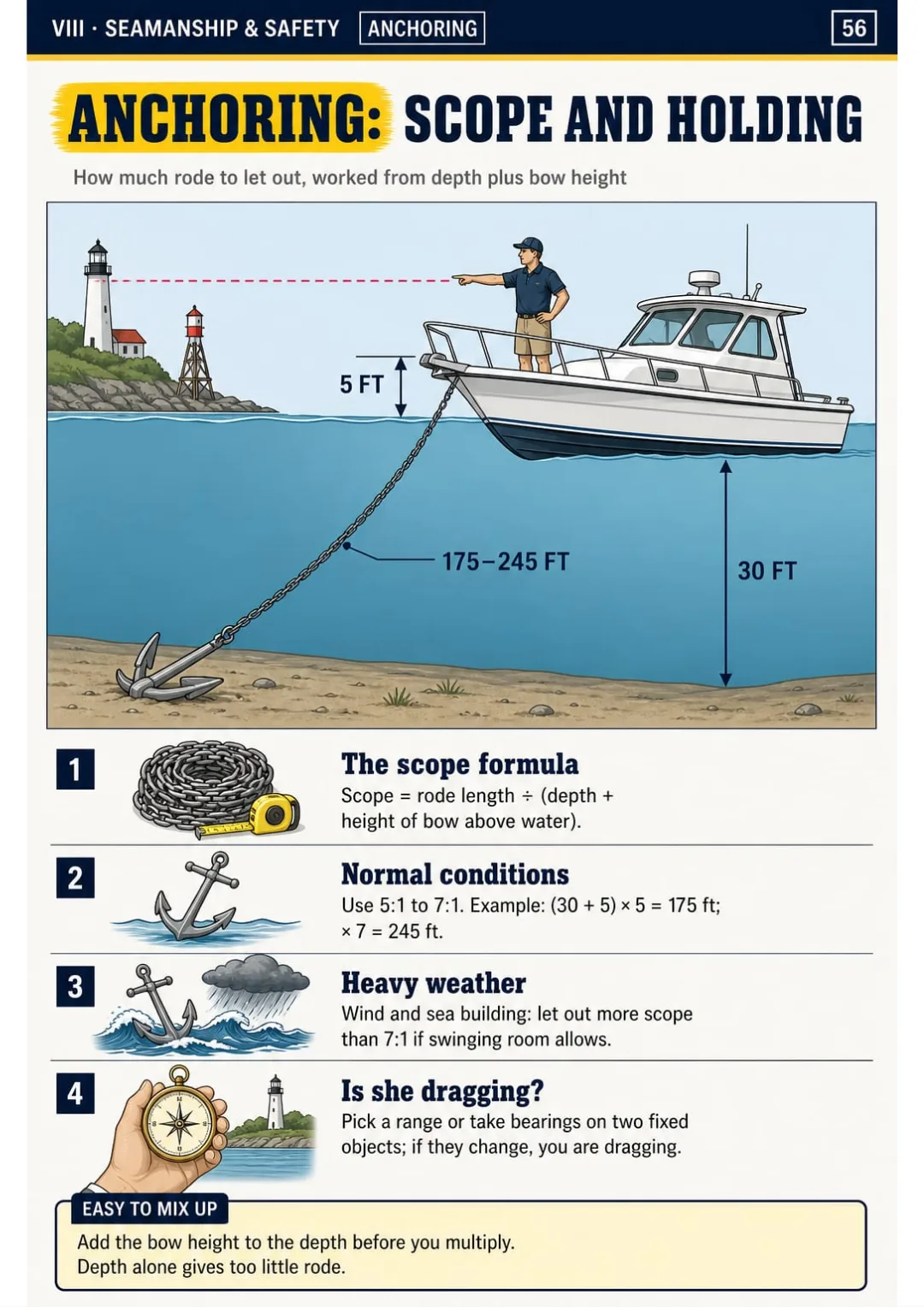
Scope = rode ÷ (depth + bow height): 30 ft + 5 ft at 5:1 to 7:1 = 175–245 ft

These are real pages from the book. The table of contents is the full one: 9 parts and 64 topics.

Four numbers around one hull, and every night-lights question starts there.

Running home after dark, a white light over a red one off your starboard bow: what are you looking at?

It's after sunset on the bay. Off your starboard bow there's one white light up high and a red one below it. To call it, you need to know which light shows from which angle.

The usual move is to open Rule 21: from right ahead to 22.5° abaft the beam, on each side. To read one pair of lights, you have to rebuild all four arcs in your head, in the right order, before you can even start on the answer.

On the page, one hull is drawn from above with four wedges around it: masthead 225°, each sidelight 112.5°, sternlight 135°, all-round 360°. A masthead light over a red sidelight means you're looking at her port side.

Masthead 225°, sidelights 112.5° each, sternlight 135°, all-round 360° (Rule 21).
Exam traps

Spot the trap before the test does

Every page ends with a note box like these: the mix-up the exam counts on.

SHORT BLAST VS. PROLONGED BLAST
p. 29 · SHORT BLAST VS. PROLONGED BLASTEASY TO MIX UP

Short is about 1 second. Prolonged is 4 to 6 seconds. Danger is five or more short.

RED RIGHT RETURNING
p. 35 · RED RIGHT RETURNINGEASY TO MIX UP

'Returning' also means heading upstream and following the conventional direction of buoyage: clockwise around the U.S. coast.

LAT, LONG AND THE DIVIDERS
p. 41 · LAT, LONG AND THE DIVIDERSEXAM TRAP

Distance goes on the latitude scale at the side, never on the longitude scale at top or bottom.

ANCHORING: SCOPE AND HOLDING
p. 56 · ANCHORING: SCOPE AND HOLDINGEASY TO MIX UP

Add the bow height to the depth before you multiply. Depth alone gives too little rode.

Price US$ 27 US$ 63

I want these pages
What you'll see

All the content, part by part

From the license and the paperwork, through who gives way, lights, sound signals, buoys, plotting and tides, to seamanship, the safety rules and a review for exam day.

I

The OUPV License and the Exam

pp. 5-9
  • Six-Pack vs. Master: What OUPV Lets You Do
  • Sea Time: Counting Your Days
  • Inland, Near Coastal or Great Lakes: Your Route
  • The Paperwork Before the Test
  • The Exam Modules and the Passing Scores
II

Rules of the Road: Who Gives Way

pp. 10-19
  • International or Inland: Which Rules Apply Here
  • Lookout and Safe Speed (Rules 5 and 6)
  • Is There Risk of Collision? (Rule 7)
  • Action to Avoid Collision (Rule 8)
  • Overtaking: More Than 22.5° Abaft the Beam (Rule 13)
  • Head-On: Both Turn to Starboard (Rule 14)
  • Crossing: The Boat on Your Starboard Side (Rule 15)
  • Give-Way and Stand-On: The Three Stages (Rules 16 and 17)
  • The Pecking Order (Rule 18)
  • Narrow Channels and Traffic Separation Schemes (Rules 9 and 10)
III

Lights and Day Shapes

pp. 20-28
  • The Arcs: 225°, 112.5°, 135° and 360°
  • Power-Driven Vessels Underway
  • Sailing Vessels Underway
  • Towing Astern
  • Pushing Ahead and Towing Alongside
  • Fishing Vessels
  • Not Under Command and Restricted in Ability to Maneuver
  • At Anchor and Aground
  • Pilot Vessels, Divers and Day Shapes at a Glance
IV

Sound Signals and Restricted Visibility

pp. 29-34
  • Short Blast and Prolonged Blast
  • International: Signals of Action
  • Inland: Signals of Intent and Agreement
  • Fog Signals Underway
  • Fog Signals at Anchor and Aground
  • Conduct in Restricted Visibility (Rule 19)
V

Buoys and Aids to Navigation

pp. 35-40
  • Red Right Returning
  • Shapes, Colors and Numbers
  • Preferred Channel Marks
  • Non-Lateral Marks
  • Light Characteristics on the Chart
  • Intracoastal Waterway and Western Rivers
VI

Charts, Compass and Plotting

pp. 41-49
  • Latitude, Longitude and Measuring Distance
  • Reading Chart No. 1 Symbols
  • Depths and Heights: Two Different Datums
  • Variation and Deviation
  • True, Magnetic, Compass: The Same Procedure Every Time
  • Speed, Time and Distance: 60D = ST
  • Dead Reckoning and Labeling the Plot
  • Fixes and Running Fixes
  • Set, Drift and Course to Steer
VII

Tides, Currents and Weather

pp. 50-55
  • Reading the Tide Tables
  • Height of Tide at Any Time
  • Bridge Clearance
  • Tidal Currents: Flood, Ebb and Slack
  • Weather: Highs, Lows and Fronts
  • Fog and Small Craft Warnings
VIII

Seamanship, Safety and Regulations

pp. 56-63
  • Anchoring: Scope and Holding
  • Stability: G, B and M
  • Life Jackets and Distress Signals
  • Fire: Classes and Extinguishers
  • Person Overboard and Cold Water
  • VHF Radio: Channels and Distress Calls
  • Pollution: Oil, Garbage and Sewage
  • Marine Casualties, Drugs and Alcohol
IX

Exam-Day Review

pp. 64-68
  • Night Lights: Name the Vessel at a Glance
  • International vs. Inland: The Differences in One Page
  • Ten Pairs That Are Easy to Mix Up
  • Plotting Checklist Before You Mark the Answer
  • Test Day: How the Exam Works

At the end of the book: An exam-day review: night lights at a glance, International vs. Inland on one page, ten easy-to-mix-up pairs and a plotting checklist
A different way to learn

The jurisdiction question, settled from your position on the chart

A text manual
  • Hunting through 33 CFR Part 80 to find where a demarcation line runs.
  • Trying to remember from a list which waters fall under which rules.
  • Asking at the marina whether the harbor you're in counts as inland.
Seaward of the 33 CFR 80 line: COLREGS. Shoreward: Inland Rules, 33 CFR 83.
This book
  • A chart sketch with the line drawn across the harbor mouth.
  • Seaward on one side, COLREGS; shoreward on the other, Inland Rules, 33 CFR Part 83.
  • Your position checked against the line, the same way every time.

Who it's for

I'm just starting to study

I'm just starting to study

You get the exam in the order it's built, starting with what the license covers: under 100 GRT, six passengers or fewer, crew not counted. Then each rule follows on its own page.
I've run boats for years, but by feel

I've run boats for years, but by feel

What you already do at the helm gets its name and number, without explaining what port is. Red right returning, for example: red even marks to starboard, numbers climbing as you head in.
My exam date is set

My exam date is set

The review pages and the boxes labeled EXAM TRAP mark the pairs that are easy to mix up. The plotting checklist walks you through true, magnetic and compass before you mark the answer.

Price US$ 27 US$ 63
I want the PDF book

Boat Captain: The USCG Exam + 2 bonus books

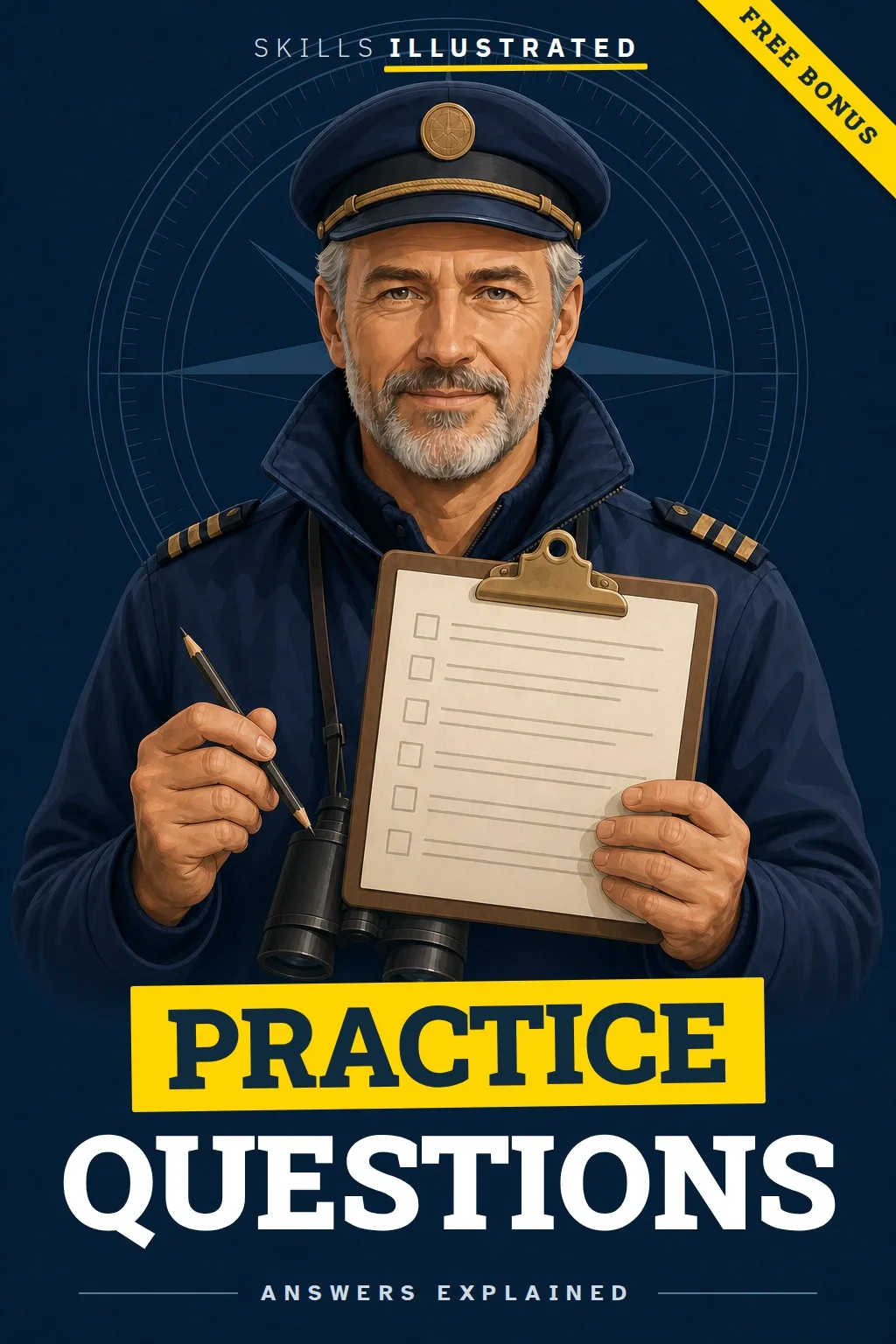
Bonus 1Practice Questions

«Practice Questions»

Check yourself in the exam's own style and read why each answer is right, so you find the weak spots before test day does.
US$ 17.90 FREE
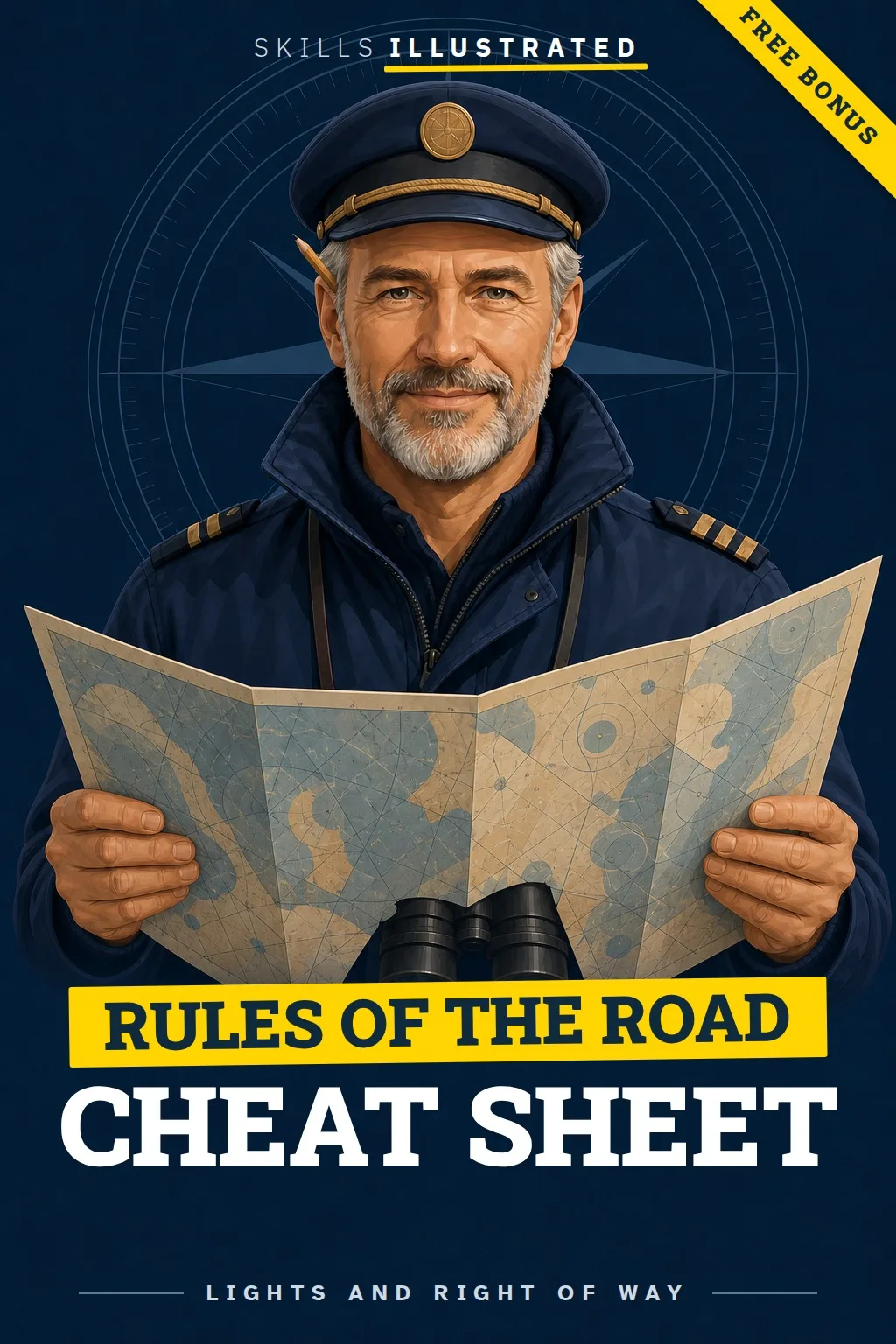
Bonus 2Rules of the Road Cheat Sheet

«Rules of the Road Cheat Sheet»

Every right-of-way situation, light and day shape on charts you can read at a glance, ready to print and keep on the boat.

US$ 14.90 FREE

Boat Captain: The USCG Exam + 2 bonus books

  • Boat Captain: The USCG Exam: 68 pages in 9 partsUS$ 63
  • Bonus 1: «Practice Questions»US$ 17.90
  • Bonus 2: «Rules of the Road Cheat Sheet»US$ 14.90
  • High-resolution PDF to printIncluded
Total value US$ 95.80US$ 27You save US$ 68.80
I want Boat Captain: The USCG Exam for US$ 27

📄 This is a digital PDF book sent to your email: nothing is printed or shipped.

  • Secure purchase
  • Encrypted payment
  • 30-day guarantee

PDF by email: We email you Boat Captain: The USCG Exam as a PDF, together with the two free books. It's a single payment: no installments, no extra charges.

30DAYS

30-Day Guarantee

Try Boat Captain: The USCG Exam for 30 days, bonus books included.

We refund everything if the file won't open, if the book isn't what you see here, if you were charged twice or if the email doesn't arrive. Just email us.

You pay once. No subscriptions.

What people ask most

How do I get the book?

As a PDF by email: the book and both bonus books.

Is it a one-time payment?

Yes. You pay once, with no subscription and no recurring charges.

Is this for the U.S. Coast Guard OUPV exam, or general boating material?

It's built for the USCG OUPV six-pack credential in the United States. It uses U.S. rules, U.S. buoys and U.S. charts and tide tables, with feet and nautical miles.

Does it replace a USCG-approved course or my sea time?

No. It's study material to use before or alongside a USCG-approved course. It doesn't come with a certificate, doesn't count toward your credential and doesn't replace sea time or the official requirements. It's independent study material, not affiliated with the USCG or the National Maritime Center, built on the official sources. No book can guarantee you'll pass.

Where does the content come from?

From the USCG Navigation Rules and Regulations Handbook (33 CFR Parts 80 and 83), 46 CFR Part 10, the U.S. Aids to Navigation System, U.S. Chart No. 1 and NOAA tide and current predictions. Every figure on a page cites its source.

I've been on the water for decades. Is this too basic?

It doesn't stop to explain port and starboard. It goes straight to what the exam asks: arcs in degrees, stand-on and give-way duties, blast lengths and conversions worked step by step.

I already have the Navigation Rules book and free videos. What does this add?

The Rules book gives you the legal text, and videos run at their own pace. Here the situation is drawn from above, the arc, rule number or steps sit in a box, and the pairs that are easy to mix up are marked side by side.

Can I print it and keep it on the boat?

Yes. The PDF prints on standard letter paper, and the Rules of the Road Cheat Sheet is designed to be printed and kept aboard.

How does the refund work?

You have 30 days. We refund everything if the file won't open, if the book isn't what you see on this page, if you were charged twice or if the email doesn't arrive: just email us.

It's a PDF: read it on screen or print it

One book, one page per topic and 30 days to try it.

Start with the first page.

One-time payment: US$ 27 · Guarantee: 30 days · PDF by email

I want Boat Captain: The USCG Exam for US$ 27

📄 This is a digital PDF book sent to your email: nothing is printed or shipped.

US$ 27Get it